Space Talk with Scott: Jan 4, 2020

RASC Vancouver’s Scott McGillivray talks about how the recent discovery of a massive black hole was a mistake and the brightness of Betelgeuse.

https://globalnews.ca/video/rd/ffc0a398-2f33-11ea-8138-0242ac110003/?jwsource=cl

Betelgeuse, a bright star that is a shoulder in the constellation Orion, has observably dimmed in recent months leading to speculations that it may be getting ready to die in a fiery supernova explosion.

General Assembly 2020 Open for Registration

You can now register and book accommodation for the RASC 2020 General Assembly.

RASC 2020 General Assembly Logo

Book early to reserve a room at a discounted group rate and take advantage of early-bird pricing that is in effect until Feb 15th, 2020.

The General Assembly, or GA, takes place at the Executive Plaza Hotel & Conference Centre on North Road in Coquitlam – just a 5 minute walk from the Lougheed Skytrain Station – from June 5th to 7th, 2020. The GA is an excellent opportunity for members of the RASC and the public to gather and strengthen the bonds of community.

The GA is of particular interest to RASC members from across Canada but all astronomy and space enthusiasts, including non-members, are encouraged to register. The GA is green, inclusive, and youth-friendly.

The Stars Belong to Everyone!

New Council for 2020

RASC Vancouver Council for 2020

Here is the new RASC Vancouver Council from the Dec 2019 Annual General Meeting. Visit the contacts page for email addresses and more information.

(Left to right) Back-row : Alan Jones (VP, AOMO), Scott McGillivray (PR & AOMO), Kyle Dally (Merchandise), Ken Arthurs (Telescopes & Observing), Ken Liu

Front-Row: Phil Lobo (Treasurer), Ken Jackson (Webmaster), Gordon Farrell (President & NOVA Editor), Leigh Cummings (LPA), William Fearon (Library), Francesca Crema (Membership), Suzanna Nagy (Secretary & Membership).

Missing: Halley Miller (Events and National Rep), Robert Conrad (Observing & Education), Andrew Krysa (Education), Howard Trottier (at-large), Bill Burnyeat (at-large), J. Karl Miller (Honorary President).

Dec 26th Annular Eclipse Report

Annular Eclipse Dec 26th Image
Eclipse Photo from Malacca, Malaysia, Dec 26th 2019. Image credit Milan B.

I was really lucky today, got to see most of the eclipse while sightseeing in coastal port of Malacca (Melaka). The photos were taken around the maximum eclipse which was at 13:17 local time. The magnitude was around 0.95 while about 92% of the Sun was eclipsed by the Moon. It was a little eerie, dark but not too dark, shadows were really unusual, but in this town full of tourists today very few people were aware of what was going on high up in the sky. My camera was hand held as well as the solar filter (my son was helping me). All in all, it was an awesome event and made me very happy. The next eclipse is also annular and will be happening in Northern India among other places, so very doable for me.

by RASC Vancouver member Milan B from Malacca, Malaysia

The final “Ring of Fire” solar eclipse of 2019 occurred early on December 26th spanning the Indian Ocean region from the Middle East to the western Pacific. An annular solar eclipse occurs when the Moon is visually too small to completely cover the disk of the Sun, leaving in a bright “annulus” or “Ring of Fire” surrounding the Moon.

Most annular solar eclipses occur when the moon is near apogee, the farthest point in its orbit around Earth – so it appears smaller as seen from Earth. This Dec 26th eclipse is unusual in that the moon is not near apogee – it is almost exactly at its mean distance from Earth. In this eclipse, the moon is still too small to cover the sun’s disk completely because the Earth is close to perihelion, its closest point to the sun for the year – so the sun appears larger as seen from from Earth.

A Unicorn Spitting 400 Meteors per Hour

Possible meteor shower in Monoceros – the Unicorn!

Radiant for the Monocerotids Meteor Shower

“What’s rarer than seeing a unicorn? How about a unicorn spitting meteors at the rate of 400 per hour?”

lead in from Sky & Telescope’s Nov, 2019 article on the Alpha Monocerotids meteor shower

A meteor shower is possible this week on the evening of Thursday Nov 21st and extending into the early morning on Nov 22nd. Meteor forecasters Esko Lyytinen (Finnish Fireball Network) and Peter Jenniskens (NASA/Ames) predict this could cause another outburst of alpha Monocerotid meteors.

During previous outbursts, in 1925 and 1935, activity reached meteor-storm levels with a zenithal hourly rate (ZHR) of more than 1,000. Near-storm level ZHRs around 700 to 400 were experienced in 1985 and 1995. Conditions this year are nearly the same as those in 1995 leading Lyytinen and to Jenniskens to predict a ZHR of 400.

The peak rate is centered at 08:50 PM PST on Thursday November 21st. The show is expected to be brief, with the peak rate lasting only 15 to 45 minutes. The meteors can appear anywhere in the sky but the paths of meteors will appear to originate from a point in the constellation Monoceros, near the bright star Procyon. The predicted ZHR is an over-estimate based on the extending the peak rate to a full hour, observing at the zenith with very dark skies. The best case, for real observing at a good location, might be closer to a maximum of 5 meteors per minute.

There is some good news & bad news for BC observers:

  • The current weather forecast looks somewhat favourable, partially cloudy is pretty good for this time of year in our temperate rainforest.
  • The radiant will be below the horizon during the shower peak which may compromise the view, but a few long earth-grazers may appear shooting upward from the eastern horizon.
Monoceros & Procyon rising one hour after the expected peak of the meteor shower.
Nov 21st, 2019 21:50 PST from Vancouver

It is still worth going out for a look. Try to find a dark place with an open view to the east.

Learning about Gravity Waves

Jess McIver‘s talk on Cosmic collisions observed with Advanced LIGO at last Thursday’s public monthly meeting was an eye-opener for me. I knew little about gravity waves and her talk was filled with fascinating facts. The following are some of the highlights for me.

Gravity waves are produced by asymmetric events like two black holes in close orbit around each other or a fast spinning neutron star with bumps on its surface.

The LIGO detectors are incredibly sensitive interferometers that can sense changes in length up to 10,000 times smaller than the width of a proton.

Schematic layout of a LIGO interferometer

There are 4 operational gravity wave detectors around the world: LIGO in Livingston Louisiana, another LIGO close by in Hanford Washington, GEO600 in Germany, and VIRGO in Italy. Another detector in Japan is expected to become operational within the next few months.

Gravity wave detectors are more like microphones than telescopes as they can pickup events from any direction in the sky. The current detection techniques assume that detectable events are rare so they don’t have to take into account two events at the same time in different parts of the sky.

It can be better to listen to gravity wave signals rather than using our eyes as is done with light-based astronomy. You can even download ringtones made from gravity wave sounds by The Albert Einstein Institute Hanover.

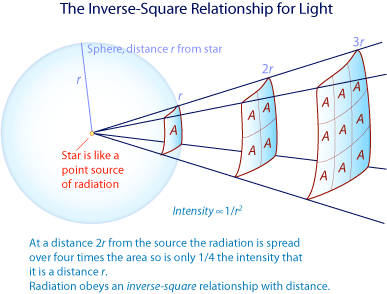
The strength of a gravity wave signals drops off proportionally with distance. This is quite different from how light works where the strength of the signal drops with the distance squared.  So there is hope in detecting ultra-distant gravitational waves. Improving the sensitivity of a detector by 100 times means we can see 100 times farther, rather than the 10 times farther that we could see with a light detector that was 100 times more sensitive. Very Cool! I had to look up more information on this one and found more details in this Forbes article.

Signals are found using matched filtering, in which data from detectors are cross-correlated with a theoretical waveforms constructed from Einstein’s general relativity equations applied to events like black-hole merges.

The gravitational-wave event GW150914 observed by LIGO

Gravity waves may be a good tool for exploring dark matter since dark matter is affected by gravity, but it may hard to detect signal from dark matter unless it clumps into compact objects like black holes or neutron stars.

The Gravitational Wave Open Science Center provides open data from gravitational-wave observatories, along with access to tutorials and software tools.

Citizen scientists all over the world are contributing to LIGO research with Gravity Spy.

Nova Newsletter – Nov/Dec 2019

Our NOVA Newsletter for Nov-Dec 2019 is available as a pdf file. An archive of older issues can be found on our Newsletter page.

Contents of Volume 2019, Issue 6, Nov-Dec 2019:

Manning Park Dark Sky Event Beginner’s Weekend, by Suzanna Nagy

President’s Message by Leigh Cummings

Manning Dark Sky – Intermediate Weekend by Ken Jackson

Why Star-Hop? 14 Reasons by Robert Conrad and Andrew Krysa

Donate Surplus To Radio Telescope Project

RASC Vancouver has started a project to setup a radio telescope and we are asking for donations of surplus equipment such as the following:

  • Laptops (maybe you have one from your latest upgrade, want a new one and need an excuse 😀). The laptops will be used, with radio astronomy software, for a portable setup at RASC Vancouver events,
  • Antennae and large dish antennae,
  • Cabling,
  • Radio receivers,
  • Ham radio equipment.

You never know what will be useful since we are just starting out. If you have equipment to donate then email Ken Arthurs, our Director of Telescopes at [email protected].

The Sept/Oct edition of our NOVA newsletter has an article that describes our initial forays into radio astronomy.

RASC 2020 GA Announcement & Survey

The RASC Vancouver Centre is hosting the RASC 2020 General Assembly! We are planning an exciting series of talks, presentations, speakers, and public outreach activities.

GA 2020 Announcement and Survey

The 2020 GA will be held from Friday, June 5 to Sunday, June 7 at the Executive Plaza Hotel & Conference Centre in Coquitlam B.C. The public Helen Sawyer Hogg lecture will take place at Simon Fraser University, with an opportunity to visit the Trottier Observatory afterwards.

Keep an eye out on the GA Website for updates!
https://ga2020.rasc-vancouver.com

Help us make the 2020 General Assembly in Vancouver our best one yet! Please take a moment and fill out a survey to help Vancouver Centre estimate attendance to the 2020 GA.
https://tiny.cc/GA2020Survey

Your survey response will help the GA planning committee, and will not be made public.

Solar System Updates from the Spilkers at Oct Meeting

Linda and Tom Spilker explored the Solar System together during their work at the Jet Propulsion Laboratory. See them at our Oct meeting where they will be talking about their work along with recent updates.

Date: Thursday Oct 10th at 7:30 pm
Location: Room C 9001 in the Chemistry Building, Simon Fraser University
(just off of the south-west corner of the Academic Quadrangle).

The talk is open to the public, family friendly, and there is no charge for admission. See our meetup page for bios and a detailed campus map: https://www.meetup.com/astronomy-131/events/hfjttqyznbnb/

Topic 1: Cassini’s Intriguing New Discoveries by Dr. Linda Spilker

Dr. Linda Spilker, Cassini Project Scientist, will present updates of the highlights of Cassini’s 13-year mission of discovery at Saturn. Since the end of Cassini’s mission scientists have been teasing out new information about Saturn, the rings and moons from the huge stock of data collected during the mission. Some of the most surprising results were discovered during the final orbits of the mission, diving through the gap between the rings and Saturn for the very first time.

Speaker #2: Architecting Space Missions by Dr. Tom Spilker

Since establishing my consulting business I have worked with multiple NASA centers, such as JPL, Goddard Research Center, Glenn Research Center, and Langley Research Center, multiple universities, and private corporations and companies, on a variety of space flight mission concepts and instrument concepts. Straying somewhat (but not entirely!) from the science missions, recently I have architected a large, rotating space station for the Gateway Foundation and its operating arm, Orbital Assembly Corp. Among other important functions, that space station should make it much easier to implement planetary science missions, trips to the moon, and large telescopes in space.